Introduction
|
Astronomy is a fascinating hobby and can take many forms but one of the most appealing is observing the night sky, which may in turn lead on to finding out more about the solar system, the galaxy and the universe. Ever since the industrial revolution observing has been getting harder with atmospheric and light pollution making it harder and harder to see faint objects. Fortunately with the green revolution things might be starting to improve. Street lights are now being designed not just to be bright, but to direct the light to illuminate the street instead of the sky. The advent of apps on mobile phones now means you can have a star atlas in your pocket.
Everything we see in the night sky, even the space station, is a long way away and so can be thought of as being painted on the inside of a huge sphere. Objects in the solar system are nearer to us and thus appear to move about relative to the others; meteors flash across the sky, the space station is steadier but still moves quite quickly, the moon moves slowly but crosses the sky in hours. The planets wander about all over the place (planets are so named because they are wanderers). The stars seem to be stationary, but even they move slowly and steadily across the sky3. Because the Earth rotates on its axis once in a day, the next night the stars are back in the same place. Well almost. Because the Sun is the bigger influence in our lives, our day is regulated by the Sun, rather than the stars. There is a difference of just under 4 minutes between the solar day (when the sun is in the same place in the sky) and the sidereal day (when the stars are in the same position in the sky). Over the course of the year these "4" minutes will add up to approximately 1440 minutes4, a whole day and the sky will be in the same place as it was a year ago. As the stars are so far away they can be regarded as fixed relative to each other and can be mapped in a star atlas1. For this reason stars are referenced by the constellations they are in2. So this is why it is important to learn the main constellations, what time of year they can be seen, and how to find them. It is a bit like towns within countries. If you are going to travel the globe some idea of geography is useful. (next) Footnote 1. The stars do in fact have relative motions, but these are only detectable in powerful and precise telescopes. They can be neglected from year to year but have to be allowed for over centuries. Star Atlases are published with a stated epoch. Footnote 2. Constellations are not groups that are necessarily near to each other, but just appear to us to be so. Constellations as we know them are only relevant to Earth centric observers. Footnote 3. They don't in fact actually move, it is the Earth rotating that makes them appear to move. Footnote 4. More accurately the year is approximate 365 1/4 days. The quarters are accommodated by adding an extra day every four years. The fact that it is not exactly 365 1/4 is handled by leaving out the leap year every so often and by adding leap seconds occasionally. |
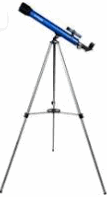 The first thought of anyone taking up the hobby is to buy a telescope. This is
a mistake. Affordable scopes that are advertised on mail order are usually not fit for purpose
and will put the enthusiast off for life. One of the first things you need to do is get familiar
with the constellations and for this binoculars are much better. No matter how much you magnify a star,
it remains a point of light. What you need is light gathering power to make dim objects a bit
brighter. Another reason to start with binoculars rather than a scope is that binoculars give a
normal view, whereas in astronomical scopes the view is inverted and back to front. This is soon
got used to if one is already familiar with the night sky, but is a bit too much for the novice to take on
board while still finding their way around. And there is much more to an astronomical telescope than
a tube that you point at the sky.
[ top ]