Princess' description
Enjoy a scenic hour drive to the Husavik village where you will board your whale
watching boat. After boarding you'll head out into the icy-blue waters of
Skjalfandi bay while relaxing with a snack and a cup of hot chocolate.
Keep your cameras ready since the waters team with marine life and you may spot harbour
seals or dolphins. on your three hour whale watching expedition you may see
any number of humpbacks, finwhales or Orcas curious enough to swim by the boat.
When you return to the dock you'll walk to a local restaurant for a delicious lunch
followed by a visit to Husavik Whale Center, Iceland's only museum dedicated to the
study of whales. Then you'll head back to Akureyri making a photo stop at
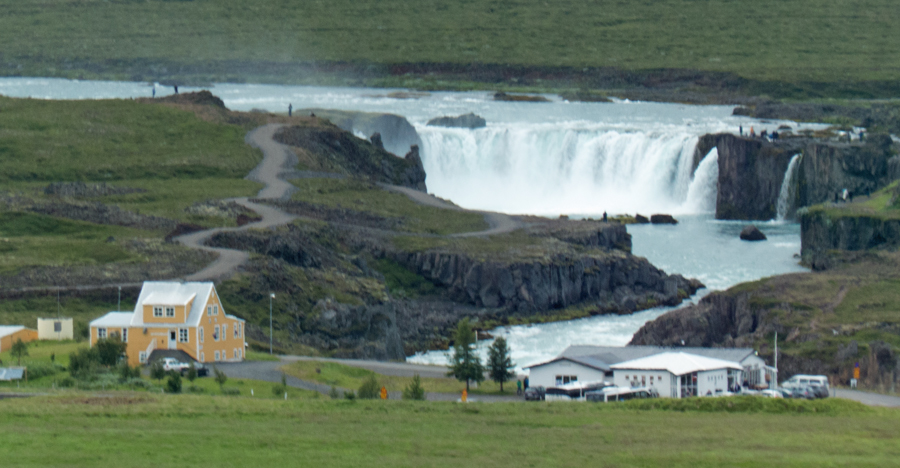
Godafos, one of Iceland's most spectacular waterfalls. |
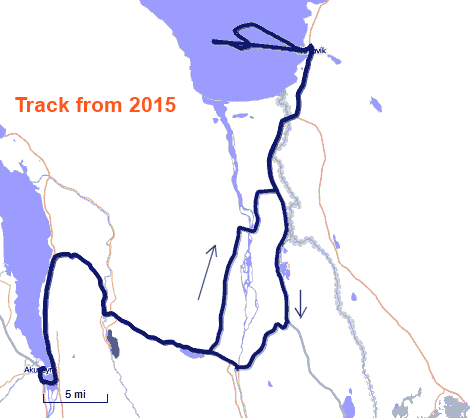 The tour didn't happen in the same order as the description, 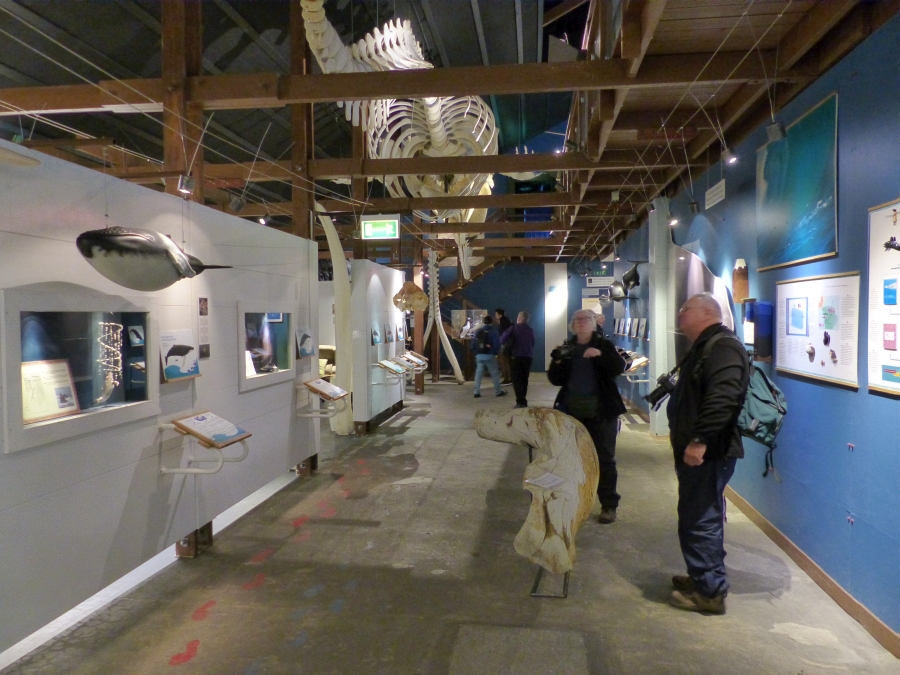 but this might depend upon the state of the tides. We went to the
whale museum first, which was a very good museum for its size, with plenty of
interesting exhibits. There was also a section where you could sit down
and have a cup of coffee and study the books they had there on whales and whaling.
There were also toilets and a shop. We had an hour there.
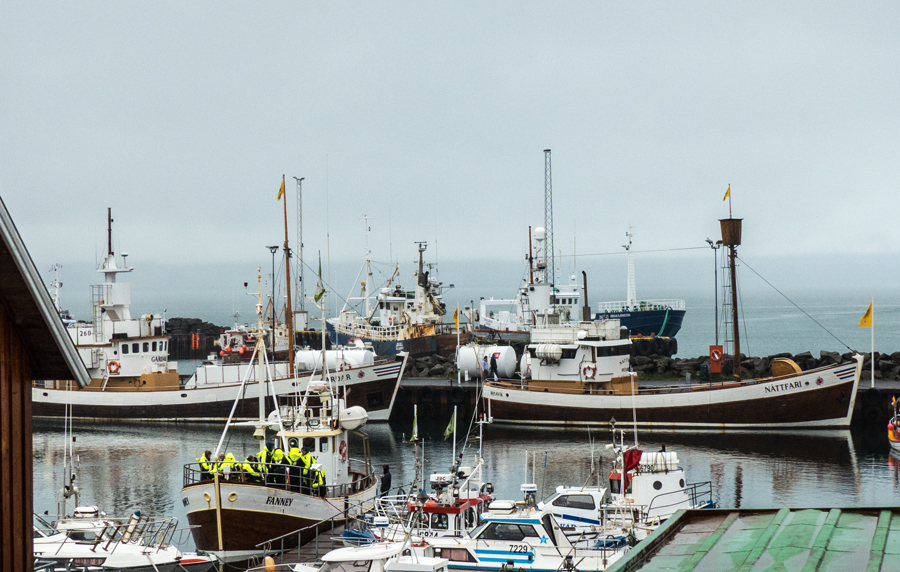 We were in the Gardar which you can see on the left against the far harbour
wall. They provided overall suits for warmth, and raincoats (full length 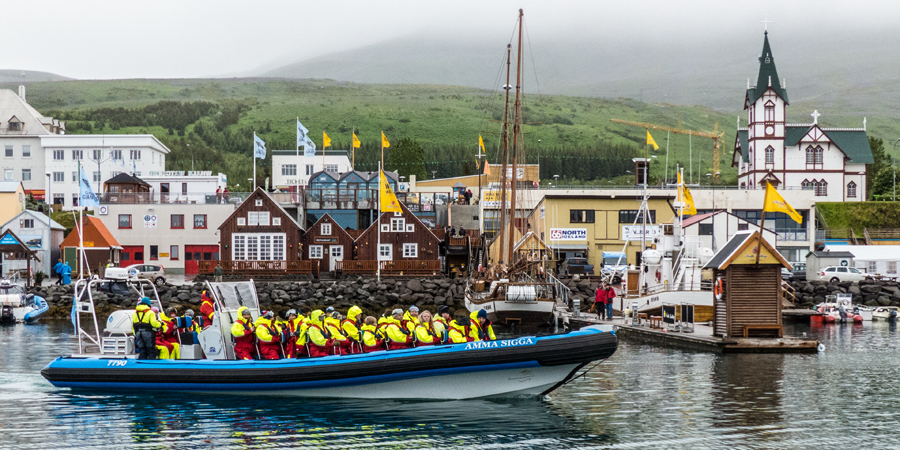 yellow oilskins) for protection against the spray. We were well wrapped up
so didn't bother, but it was cold, so if you like to stay warm take advantage.
While waiting to leave we saw some leaving on an RIB all done up in flotation suits.
Pity them. I thought, remembering the freezing trip in Honningsvag on the King Crab
safari. However they did have advantages.
It took just under an hour to reach the whale feeding grounds..
We knew we were there as there were a few other boats just hanging about doing
nothing. They had seen a spout, positioned themselves, and were waiting
for it to come up again. They do not come up in the exact same place they
went down, but usually not far away. Once the whale comes up all the boats
race towards it to be ready for the next dive. This is where the RIBs had
the advantage, as they are so much faster than the big fishing boats. They
had another advantage, better visibility. Some fishing boats are better in
that you can see either side of the boat. Our one had super-structure in the
middle so you could only see one way. This would have been alright if
the helmsman had spun the boat slowly so that everyone got a view but he just went
to where the whale was and waited. The girl commentating and calling out the sightings
did a good job. As soon as she saw a spout or a dark shape she would call
 out the bearing using the 12 hour clock system. Unfortunately the helmsman then turned
the boat in that direction invalidating the bearing and meaning it was only those in
the bows that would see anything. She also knew the whales' behaviour and
told us when it was shallow diving or deep diving. Just before a deep dive
it will hump its back and that is when you know the fluke is going to come up clear of
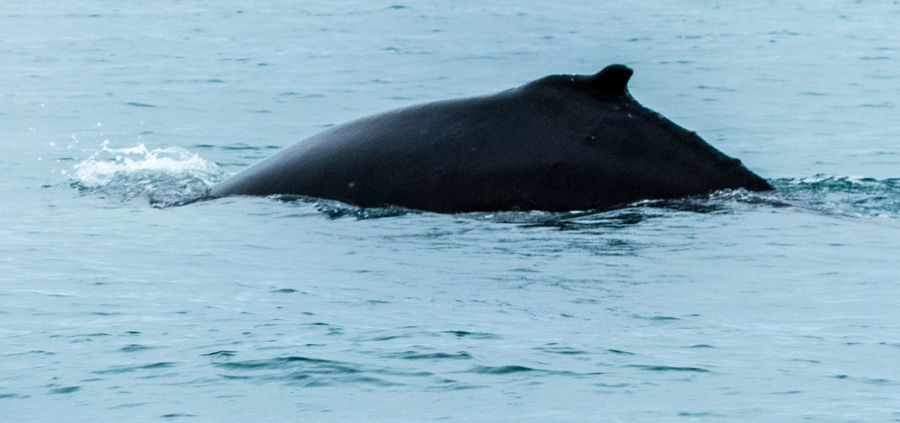
the water. Despite all the problems, Carol managed to get some good
shots. I got one shot of the humped back.
 There were two humped back whales and after about an hour of going between
the two we headed back. The tour description is more hype than accurate,
"teaming with marine life" is not a fair description. It is possibe to see
any of the animals they describe but you have to be lucky. The museum. the
boat and the restaurant are all in the same area but because the boat is on the far
harbour wall there is quite a bit of walking. The coach can not stay where
it drops you off for that length of time so moves to another car park.
There are also many steps up to the restaurant, although it is possible to walk around
to the entrance, but it is steep and further. After lunch we returned to
the ship via Godafoss waterfall.
|